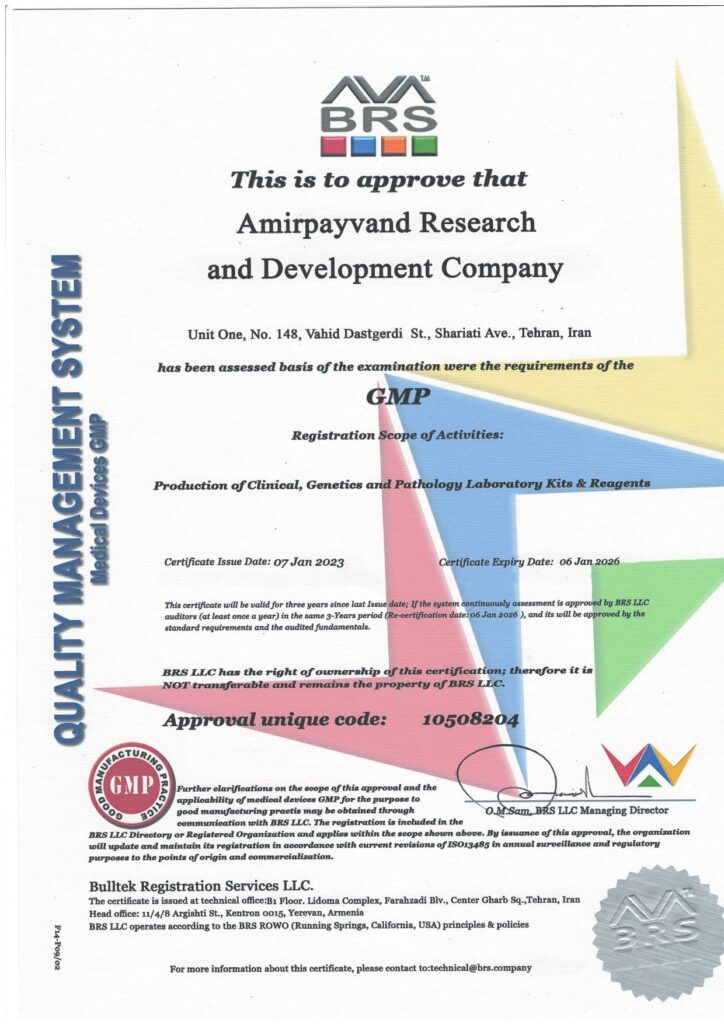

Ensuring the safety and quality of laboratory diagnostic products is a key concern for consumers today. In this regard, ap-rad has successfully obtained the GMP (Good Manufacturing Practice) certificate for the production of laboratory kits and solutions (clinical, genetic, molecular, and pathology).
The evaluation of ap-rad for obtaining the GMP certificate for appropriate production quality was conducted by BRS USA, one of the top and most reputable companies in the field of issuing international certifications for production management systems.
GMP is an important step in the quality management system for the production of diagnostic kits and solutions in the medical and laboratory fields, which increases customers’ confidence in the manufacturer’s commitment to business and producing quality products.
Compliance with GMP requirements necessitates adherence to minimum quality control guidelines applicable to all manufacturing units. Many companies in the manufacturing industries consider obtaining GMP certification for their products as a foundation upon which they develop their quality management systems and products.
The principles of GMP are control factors that are not focused solely on one specific process but oversee the entire production and quality control operation, forming the basis for manufacturing a safe product. These principles address the establishment and maintenance of suitable production infrastructures such as machinery, environment, equipment, human resources, and so on.
- Defining all production processes systematically, operationally, and in a reviewed manner, so that the capacity and capability to produce a quality product conforming to the predicted specifications is proven.
- Validating the critical and key steps of production processes and major changes in any process.
- Providing the necessary facilities and items, including: efficient, skilled, and trained personnel, suitable buildings and space, appropriate equipment, quality raw materials, correct containers and labeling; proper storage and transportation, approved guides and instructions.
- Developing clear, operational guides and instructions in simple and unambiguous language for the use of tools and equipment.
- Training production line technicians so that they are prepared to perform the processes correctly.
- Preparing documented records throughout the entire production operation, in a way that demonstrates that all steps and requirements have been carried out according to defined instructions and guides, and that the product has been manufactured with the predicted quantitative and qualitative specifications.
- It is necessary to record and investigate hazardous activities.
- Maintaining documents and records of various production stages, including complete and traceable documentation of product distribution.
- Having an efficient system for recalling sold products.
- Having a system for reviewing and investigating received complaints, investigating the cause of quality defects, and implementing corrective and preventive actions to avoid their recurrence.