
Description
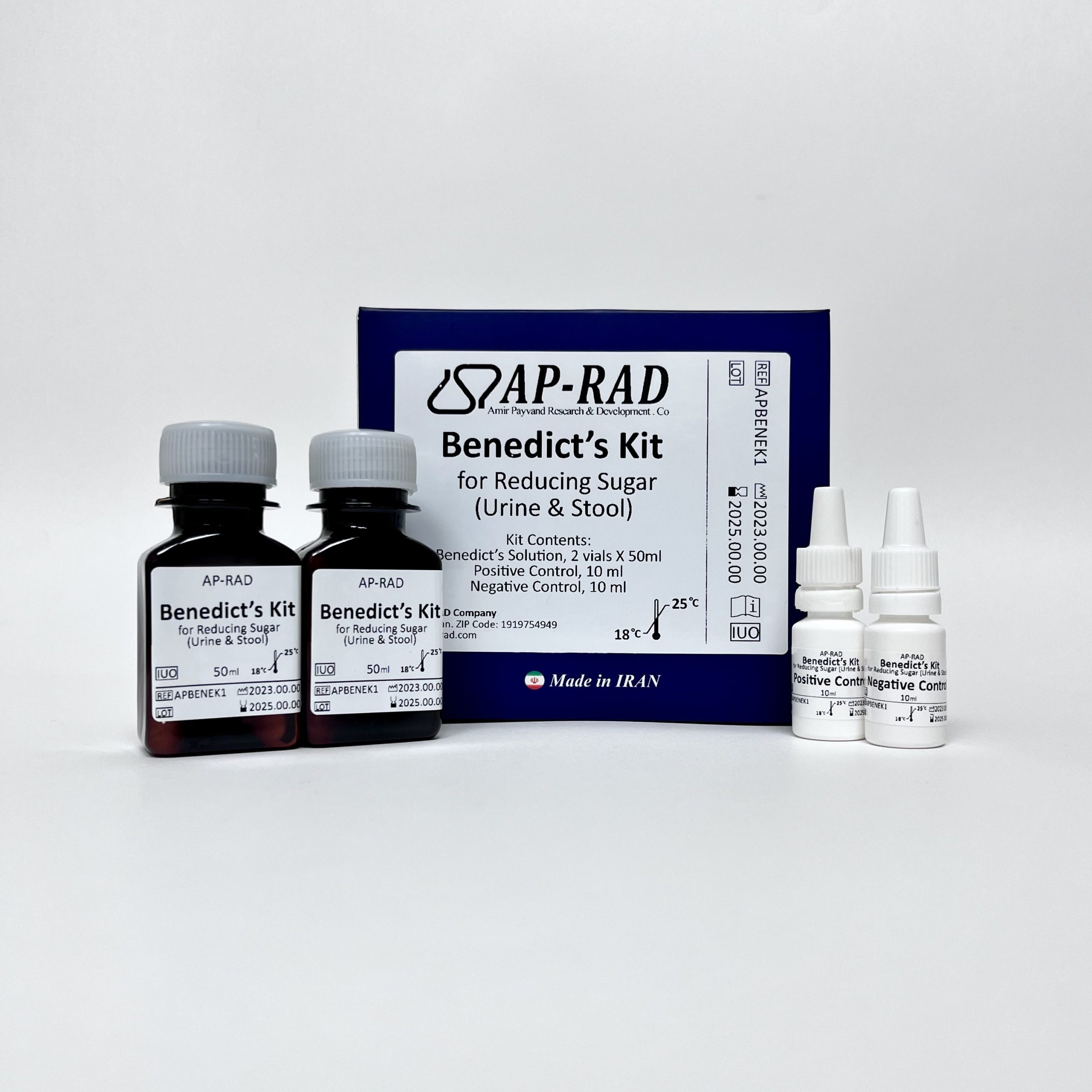
Benedict’s Test Kit | Benedict’s Kit for Reducing Sugar – Urine and Stool
The Benedict’s Test Kit is one of the simplest yet widely used laboratory tools for the identification of reducing sugars and simple carbohydrates in various samples. This test is extensively employed in medical diagnostic laboratories, educational settings, biochemistry labs, and the food industry.
The Benedict test is based on the ability of reducing sugars such as glucose, fructose, lactose, and maltose to reduce cupric ions (Cu²⁺) present in the Benedict’s reagent. As a result of this reaction and upon heating, the cupric ions are reduced to cuprous ions (Cu⁺), and a copper oxide precipitate with a visible color change forms. This color change can vary from blue, green, yellow, orange to brick red, indicating the presence and concentration intensity of reducing sugars in the sample.
Besides qualitative detection, the Benedict’s Test Kit also allows for semi-quantitative measurement of sugar levels, making it extensively useful for initial diabetes screening, urine sugar analysis, food content analysis, and educational studies. Its ease of use, lack of need for complex equipment, and straightforward interpretation of results make this kit an ideal choice for laboratory and educational environments.
Key advantages of the Benedict’s Test Kit include rapid testing, appropriate accuracy, cost-effectiveness, and applicability for a broad range of reducing sugars. This kit serves as an effective tool for the preliminary diagnosis of carbohydrate metabolism disorders and for detecting simple sugars in biological and food samples.